Archives for March 2021

COVID-19 Rental Relief Report

SAREIT Research Committee’s First Report Reflects the Sector’s Commitment to Tenants’ Sustainability

The SA REIT Association (SAREIT or the Association), a representative umbrella body for South African REITs focused on promoting the sector as an attractive asset class; today released its newly established Research Committee’s maiden report. The report unpacks the extent of the COVID-19 rental relief initiatives provided by REITs to their tenants during the pandemic. 

The REITs’ relief measures were an effort to support tenants, especially SMMEs, to ensure the sustainability of this critical segment of the economy. The rental relief was mainly in the form of discounts or deferrals, of which 80% relates to unrecoverable discounts, intended to sustain tenants’ cashflows and curb business failures.

Joanne Solomon, CEO of the SAREIT, commented: “The establishment of the SA REIT Association’s Research Committee was a critical element of our renewed strategy as we identified the need to provide research and insights into relevant topics within the South African listed property sector.

“The COVID-19 rental relief report is our first and it is encouraging to witness South African REITs’ commitment to sustaining the economy despite the severe pressure they have found themselves under due to unprecedented market conditions.” 

As part of SAREIT’s repositioning process in 2020, the Association formed the Research Committee aimed at generating and providing access to high quality, independent research related to the listed property sector in South Africa and other relevant markets, as well as act as a trusted research hub for members and the industry at large.

“In addition to support the measures put in place by the government in response to the pandemic, it was important for SAREIT to quantify its members’ contribution towards the sustainability of tenants, many of which are SMMEs playing an important part in economic growth, innovation and job creation. The report provides comprehensive insights on the sector’s prompt reaction to the crisis as demonstrated by the total R3 billion contribution made from April to December 2020, which 69% was provided by August 2020,” said Amelia Beattie, Chairman of the Research Committee. 

This is the initial of two reports, which SAREIT plans to publish on the support provided by its members, each covering the latest available periods disclosed by its membership base. 

This report’s contributors are Pranita Daya, a Real Estate Analyst at Anchor Stockbrokers; Ndivhuho Netshitenzhe, an Economist at Stanlib and Phil Barttram of Philbar Consulting.

-END-  

CONTACTS

SA REIT Association – Joanne Solomon, CEO – 082 888 9975 or joannesolomon@sareit.co.za 

Instinctif Partners – Boitumelo Nkambule – 073 265 0231 or SAReit@instinctif.com 

NOTES TO EDITORS

About SA REIT Association

The SA REIT Association promotes South African REITs as an investment class while addressing issues and meeting challenges within the sector. It is a representative umbrella body comprised of voluntary members of all listed SA REITs. SA REIT was established in 2013 to represent the interests of the sector following the introduction of the REIT structure to South Africa. 

The Association’s current strategic priorities are:

  • Strengthen relationships with investors and capital providing stakeholders to enable a deeper understanding of relevant issues
  • Provide high quality, independent research related to the SA listed property sector on matters relevant to stakeholders
  • Engage with legislators, regulators as well as other business associations and stakeholders to establish a stable, conducive policy and business environment
  • Drive advocacy through transparent, consistent reporting and accessible information
  • Position the SA listed property sector brand as a leading asset class to build relevance with selected stakeholders
  • Advocate for sustainable human, social, economic and environmental transformation within the listed property sector

Website: https://sareit.co.za/
Fairvest Maintains a Robust Performance and Forecasts Year-on-year Distribution Growth

Highlights for the six months to 31 December 2020 

  • Distribution for the period is 10.590 cents per share  
  • Net asset value per share of 229.32 cents  
  • Loan-to-value ratio decreased from 36.3% to 32.2%  
  • Arrears reduced from 4.4% to 3.1% of revenue  
  • Vacancies reduced from 4.5% to 3.8% of the total lettable area  
  • Interest cover high at 3.3 times  
  • Distribution growth forecast for the full year of 0%-2% and 100% pay-out ratio maintained 

Fairvest Property Holdings Limited (“Fairvest”) today announced results for the six months to December 2020 that portrayed strong improvements in property fundamentals and a pleasing 7.2% increase in distribution against the most recent six months to 30 June 2020,  which were at the height of the COVID-19 lockdown. When compared against the pre-COVID corresponding period of 31 December 2019, however, the distribution decreased by 5.1%.  

Fairvest maintains a unique focus on retail assets weighted toward non-metropolitan and rural shopping centres, as well as convenience and community shopping centres servicing the lower income market in high growth nodes, close to commuter networks. The Fairvest property portfolio consists of 43 properties with 250 911 m2 of lettable area, valued at R3.425 billion.  

Chief Executive Officer, Darren Wilder said that Fairvest’s specialist, niche positioning of smaller neighborhood centres with grocery-anchored assets, and an emphasis on essential shopping, with  a focused, hands-on management team has been more resilient during the COVID-19 pandemic with the recovery being quicker than anticipated, and without significant increases in vacancies.  Countrywide, food retailers demonstrated the most resilient trading densities of all merchandise categories, and smaller format retail outlets outperformed as consumers redirected their spending power toward convenience shopping closer to home.  

Fairvest’s defensive portfolio and consistent distributions track record have been well-recognized and rewarded by investors. The company has featured in the top three among the JSE’s universe of  28 SA-based REITS in terms of total return performance in each of the key investment period horizons of 1, 3, 5, and 10 years.

Resilient distributions 

Total property revenue increased by 2.3% to R274.2 million, as a result of income growth in the historic portfolio and acquisitions in the latter half of the previous financial year, offset by the disposal of Tokai Junction. Net profit from property operations increased by 4.6% to R176.5 million. 

Expenses were well contained, assisted by significant solar savings at properties, but countered by the effect of rental concessions provided to tenants, as well as the substantial increase in the provision for expected credit losses on rental billed during the COVID-19 lockdown period. 

Valuations 

On a like-for-like basis, the historic portfolio increased by 3.4% compared to the previous year. Capital expenditure of R12.5 million was incurred and a further R14.9 million was invested in solar installations, with 16 sites now completed and generating savings to the value of R5.0 million.  Installations at eight further sites will commence during the fourth quarter of the financial year, with a further R14.2 million of capital expenditure committed. 

Given the uncertainty in the current market, a conservative approach was maintained with the valuation of investment property. The weighted average exit capitalisation rate used remained unchanged at 10.3% compared to 30 June 2020, while the weighted average discount rate also remained unchanged at 14.8%. These conservative metrics continue to show prudent but fair valuations. During the period under review, Tokai Junction was sold for R180.0 million. The disposal price represents a 10.5% premium to the 30 June 2019 valuation of the property, underscoring  Fairvest’s conservative valuation of its portfolio. The sale resulted in a 1.9% decrease in the value of the property portfolio at 30 June 2020 to R3.43 billion.  

A low-risk portfolio with robust property fundamentals 

The portfolio remains strongly diversified with a broad, geographically dispersed representation and  A- and B-grade tenants who occupy 80% of the gross lettable area. The high national tenant component of 72.2% of the portfolio provides shareholders with a low-risk investment profile with national food retailers occupying 32.4% of the portfolio in terms of GLA. Tenants unable to trade during lockdowns represented less than 3.5% of monthly billings.  

The weighted average contractual escalation for the portfolio decreased from 7.2% to 7.1%. Gross rentals across the portfolio trended upwards, with a 2.7% increase in the weighted average rental to  R132.15/m2at 31 December 2020. This was because of contractual escalations, increases in rental achieved on new leases, and a 1.6% weighted average rental increase achieved on renewals. 

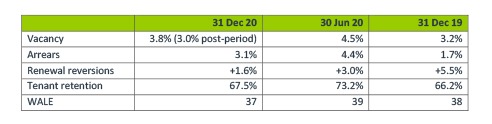
Wilder said that Fairvest is fortunate to have a team of hands-on property professionals who have deep experience in both bull and bear markets. In tough times, this experience is brought to bear to continue to achieve healthy results and sustained value creation. The stable performance and notable improvements from the height of COVID are evident in the table below.

information in table format

While vacancy rates within shopping centres across the industry reflected deteriorating tenant viability, Fairvest vacancies decreased from 4.5% to 3.8% during the period. Positive letting of vacancies after period-end resulted in the vacancy percentage further decreasing to 3.0%. During the period under review, 101 new leases were concluded with a total GLA of 19 081m2. Fairvest also successfully renewed 16 038m2 of leases, with a positive reversion of 1.6% being achieved on these renewals. Tenant retention for the period remained high at 67.5%. The weighted average lease term decreased slightly from 39 to 37 months. 

COVID-19 impact contained 

Most rent relief negotiations with tenants have been concluded during the reporting period.  Additional rental remissions of R9.7 million were conceded for the six months to 31 December 2020.  During the period net arrears decreased by 26.7% to R16.7 million. Collection of deferrals have been better than anticipated and we expect arrears to decrease further by the end of the financial year. 

Asset quality improving further 

Fairvest’s asset management initiatives resulted in improved nets cost to income ratios and further improved asset quality, with the average value per property increasing by 0.4% to R79.6 million, and the average value per square meter increasing by 2.7% to R13 650/m2

Disciplined, conservative financial management 

Wilder said that Fairvest’s balance sheet remains strong, with a conservative loan to value (“LTV”)  ratio and a comfortable interest cover ratio. The LTV ratio decreased to 32.2% (June 2020: 36.3%)  mainly due to the disposal of Tokai Junction during the period, offset by further investments in solar projects. Of the debt, 72.3% was fixed through interest rate swaps as at 31 December 2020, with a  weighted average expiry for the fixed debt of 34 months. The weighted average all-in cost of funding increased to 8.05% (June 2020: 7.57%). The increase is due to the reduction of floating rate debt with the proceeds of the Tokai Junction disposal. The weighted average maturity of debt decreased marginally from 23 months to 21 months. 

Fairvest has no debt facilities expiring for the remainder of the 2021 financial year. 

Prospects 

Fairvest said that the lasting impact of the COVID-19 pandemic on the local economy remains uncertain, given the pace of the vaccine rollout and potential further infection waves which may impact tenants.  

Fairvest remains well-positioned with a defensive portfolio of grocery-anchored assets in smaller,  more convenient centres, a conservative balance sheet with modest gearing levels, and more than

R220 million of undrawn debt facilities. The focus areas remain to maintain viable tenancies and letting of vacancies, with a strong focus to reduce arrears even further.  

After taking into consideration the uncertain environment described above, as well the performance of the past six months, the Fairvest board expects the distribution per share for the full 2021  financial year to be between 0% and 2% higher than the previous year. The board has also again resolved to maintain the current dividend pay-out ratio of 100% of distributable earnings. Any changes to this policy will be communicated to shareholders at least 12 months before any changes are implemented.  

Wilder said that Fairvest’s philosophy has always been to maintain a simple property business and to focus on the basics. “We are determined to continue to keep an uncomplicated traditional property business with a conservative balance sheet and income statement, devoid of complex financial structures. We continue to maintain and grow a portfolio of quality assets with strong property  fundamentals and to provide hands-on property management, as we strive to continue to add value  for our shareholders.” 

Closing the economic gap through genuine reform and partnerships

The spread of COVID-19 since the beginning of 2020 continues to have a devastating impact on South Africa’s s socio-economic environment. Unfortunately, the spread of the virus escalated dramatically as we entered 2021, with a fresh surge in COVID-19 cases since December 2020, resulting in the reintroduction of extended level 3 lockdown measures.

In an effort to limit the effects of lockdowns on economic activity, household income and corporate earnings, save jobs, and contain the spread of COVID-19, the government introduced several relief schemes and initiatives. These initiatives included tax relief measures, a R500 billion fiscal stimulus package and several programmes to help SMMEs and their employees across sectors most affected by COVID-19 and lockdown measures.

While many of these programmes genuinely helped some companies, the success rate is not uniform across the various schemes. On the one hand, the Tourism Relief Fund was able to disburse its total R200 million budget to help 4 000 companies. However, arguably the fund itself is not enough to address the industry’s needs. On the other hand, the performance of the R200 billion Loan Guarantee Scheme has been dismal. Since its inception, participating banks have only approved around R17.84 billion in loans under the scheme, with the value not expected to surpass R19 billion.

In terms of tax relief measures, government announced multiple measures, including several tax payment deferrals, fast-tracking VAT refunds, and a tax subsidy to employers. These measures were expected to provide support for businesses to continue operating and pay employees and suppliers.

While it’s hard to ascertain how much support companies actually received, monthly tax revenue collection data from the National Treasury shows that there has been a significant slowdown in tax collection from some tax categories beyond the effects of slower economic activity. For instance, from April to December 2020, the skills development levy collection contracted by 44.5%, the most significant drop in any tax category. At the same time, VAT refunds throughout the year have accelerated, growing from about R16 billion in February to over R20 billion in December.

The COVID-19 related lockdowns led to a substantial decline in South Africa’s economic growth in the second quarter of 2020. Positively, GDP growth rebounded at the start of the second half of 2020, surging by a massive 66.1% quarter-on-quarter, seasonally adjusted and annualised. While the bounce back in economic activity resulted from the lifting of the severe COVID-19 lockdown measures, the cuts in interest rates by the SA Reserve Bank and the increased and extended social payments and other relief measures by the government provided further support.

Although the South African economy improved far more than expected in Q3 2020, the subsequent resurgence in COVID-19 infections unfortunately dampened the recovery into the first part of 2021. For 2020, South Africa’s GDP is expected to have contracted by around -7.4%, while for 2021, GDP growth is forecast at around 3.5%. Considering that between 2015 and 2019, South Africa achieved an average annual growth rate of only 0.8% and a mere 0.2% in 2019, growth of 3.5% in 2021 appears encouraging. Still, it is well below the level of output required to reverse the losses experienced in 2020. South Africa’s economic growth needs to be at this level on a sustained basis to generate a meaningful increase in employment.

The main driver of the economic recovery is the strong base effects, as all sectors of the economy continue to recover from historic lows. In addition, the global recovery should support South Africa’s rebound. A generally weaker rand, coupled with strong commodity prices should boost key mining exports, also helping South Africa’s economic performance.

Given that consumption makes up almost 60% of South Africa’s GDP, the rebound in retail activity and the service sector will be important in South Africa’s growth trajectory for 2021. The consumption recovery is expected to be led by high-income consumers who have kept their jobs and maintained their income during the pandemic. While the sharp rise in joblessness disproportionally affected low-income consumers, they benefitted from the top-up in social grants, the COVID-19 relief of distress grant and employment programmes. The historically low interest rates and the subdued inflation rate has also led to a recovery in retail activity, although this has been uneven and relatively slow.

Although the recovery in economic growth is highly dependent on the successful distribution of effective COVID-19 vaccines, this could be stalled by ongoing load shedding and the threat of government implement stricter lockdown measures in response to any future resurgence in infections. Consequently, limiting the spread of the virus, providing relief for vulnerable populations, and overcoming vaccine-related challenges are key immediate priorities for South Africa.

In trying to improve South Africa’s growth performance in the medium to long term, this year’s National Budget’s policy choices reflect that fiscal policy is currently ineffective in directly revitalising the South African economy. In particular, government cannot afford to cut taxes extensively to boost household consumption and corporate investment given the extreme fiscal constraints. Equally, the National Treasury has very little scope to meaningfully further increase public spending, given that its current debt trajectory has worsened considerably.

With that said, government’s growth initiatives need to move ahead rapidly in trying to initiate a wide range of private/public partnerships to stimulate growth and employment. This includes continuing to make it easier to do business. Fortunately, there is a clear intention on the part of government to implement a range of drastic changes to the government’s budget in order to control expenditure, but at the same time find a way to implement a series of growth-friendly policy initiatives, including government’s infrastructure initiative.

Ultimately, the success of the government’s growth and employment agenda in 2021 and beyond will be determined not by the quality of its policy documents but instead by its ability to make progress in implementing real reforms that encourage the business sector and population in general. Closing the gap between South Africa’s current trend growth rate, and a modest target of 3% on a sustained basis is going to require a significantly greater implementation effort than is currently evident, including the coordination of economic policy across key government departments and actively partnering with the private sector.

Impact of Covid-19 still felt but Hyprop makes very good progress implementing revised strategy

Hyprop, the retail-focused REIT with a R45.4 billion portfolio of shopping centres in South Africa, Eastern Europe and sub-Saharan Africa, improved its distributable income by 18% in the six months to 31 December 2020 compared with the six months to 30 June 2020.

Distributable income was R473 million for the period, after the direct impact of Covid-19 which was R244 million across the total portfolio. Hyprop extended a lower level of Covid-19 related discounts to tenants in the second half of calendar 2020 than in the first half, with R104 million of rental discounts on the South African portfolio granted in the second half of calendar 2020.

“Trading conditions continued to be difficult, especially in December 2020, as lockdown restrictions affected trading hours, seating capacity and the psyche of many shoppers. As a Group we focus on the things we can influence and we are making good progress implementing our strategy,” says CEO Morné Wilken.

“The support we provided for our tenants has strengthened our partnerships with them and other service providers, helped us to manage vacancy levels, retain key tenants and ensure that our malls continue to be functional and serve their communities.

“Hyprop remains committed to creating safe environments and opportunities for people to connect and have authentic and meaningful experiences. While Covid-19 has changed our operating environment, we have ensured that our strategies and key priorities remain relevant.”

Hyprop reduced interest-bearing debt by R942 million in the last six months, settled all its dollar equity debt, and strengthened its balance sheet even further by retaining R777 million from its distributions for the 2020 financial year. The loan to value (LTV) ratio has reduced from 41.4% as at 30 June 2020 to 38.8% and ICR remains healthy at 2.6 times.

At the end of December, Hyprop had R528 million of cash on balance sheet and undrawn facilities of R1,15 billion.

Regional overview

South Africa

In South Africa (SA), vacancies in the retail portfolio increased to 3%, which is still well below the average of its peers in the market. Rental increases remain under pressure and tenants are showing a reluctance to commit to long-term leases until conditions improve. This may however be beneficial in the long run as the impact of Covid-19 dissipates, and the benefits of repositioning the SA portfolio accrue to justify higher rentals on future renewals.

We have completed phase one of installing free, high-speed Wi-Fi at all our South African malls and will shortly begin phase 2.

New lettings included the opening of a Checkers FreshX in Rosebank Mall in December 2020. The old Game premises at Woodlands Boulevard is being replaced by a Checkers FreshX store and a Stax. We have also agreed terms with Checkers to upgrade their store at CapeGate to the Checkers FreshX specification. There is heightened interest in Hyde Park Mall, where we have, among other new tenants, secured Tshepo Jeans, a fast-growing brand with a large social media following that marks the emergence of new, entrepreneurial retailers. KOL, a new restaurant and co-working space established by the founders of Willoughby’s, will open at Hyde Park Corner in March 2021.

Emphasising the importance of relevance and sustainability of Hyprop centres as key, Wilken comments: “We are currently piloting several initiatives to improve foot count, one of which includes the Pargo collection points at Canal Walk and The Glen. It is encouraging to see that collections at these points are steadily increasing. A number of these collections are for products not sold in our malls, meaning that we are broadening our customers’ choices without increasing lettable area. Parkupp is a parking app that gives users the ability to secure parking on a flexible basis and is being tested at Canal Walk and Rosebank Mall.

“The first SOKO district pilot at Rosebank Mall is on schedule to open in June 2021. SOKO means “market”, and the SOKO District will be a marketplace where retailers can rent space and reusable shop fittings via a flexible digital leasing platform, without the significant financial commitments that exist in the traditional retail environment. The leasing platform is powered by data driven shopper, product and trend analyses, that will result in location recommendations that match retailers, products and shoppers, across our portfolio.”

Eastern Europe

Our interests in Eastern Europe (EE), held through a 60% stake in UK-based Hystead Limited, reflect a continued difficult trading environment. Recovery from the first wave of lockdowns was slow and in November 2020, when a second wave of infections hit the region, restrictions were re-imposed. However, with the roll-out of vaccines in Europe, we expect conditions to improve in the second half of 2021.

The vacancy in the EE portfolio was 0.4% at end-December. 23 new stores were opened in the six-month period, and another 23 are planned for the first quarter of this year. Replacement tenants have been secured for six of the seven stores to be vacated by the Inditex Group as part of their restructuring. The countries where our malls are located were in good economic standing before Covid-19 and we believe our malls will bounce back quickly as vaccines are rolled out and the impact of Covid-19 dissipates.

Sub-Saharan Africa

Hyprop has previously announced plans to reduce its exposure to sub-Saharan Africa. The previously announced disposal of our 75% interest in Ikeja City Mall in Nigeria remains subject to the fulfilment of certain conditions.

Since the relaxation of trading restrictions in Nigeria and Ghana, key metrics have improved and trading densities for 2020 are higher than in 2019.

Outlook

In the short-term, Hyprop’s strategy will centre around reducing its debt further, limiting capital expenditure to projects already committed or essential, continuing the disposal of assets such as those in the sub-Saharan portfolio and Atterbury Value Mart, as well as recycling other assets that do not fit into our long-term strategy.

On a longer-term basis, the Company will continue to reposition the SA portfolio, increase the dominance of the properties in the European portfolio, and pursue the non-tangible asset strategy.

“Although we expect to face further challenges in the next two years, we believe the strength of our dominant retail centres in mixed-use precincts in key economic nodes within South Africa and Eastern Europe, our partnerships with our tenants and the agility of our responses will enable Hyprop to meet and overcome these challenges,” says Wilken.

“Our initiatives to grow the group’s non-tangible asset base are being intensified and we are making good progress.”