
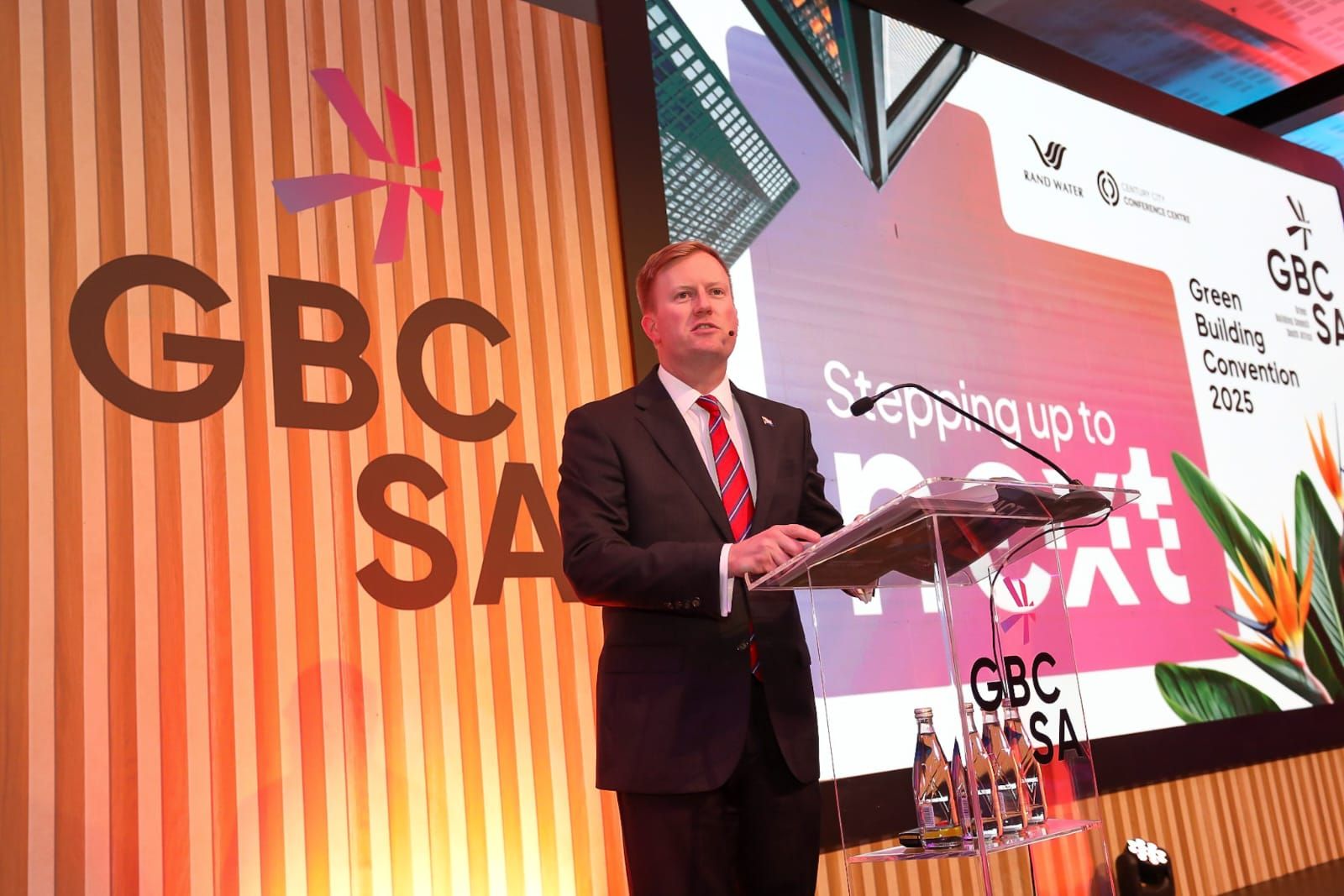
In a landmark announcement at the Green Building Council South Africa (GBCSA) Convention on 11 November 2025, Minister of Public Works and Infrastructure Dean Macpherson outlined an ambitious vision that positions government buildings at the forefront of South Africa’s sustainability transformation.
Leading by example
During his keynote address on the opening day of the convention, Minister Macpherson announced that the Department of Public Works and Infrastructure (DPWI) has formally joined the Green Building Council South Africa as part of its wider reform programme, marking a pivotal shift in how government approaches its role as the country’s largest landlord. This move signals a new era of accountability and leadership in sustainable building practices across thousands of state-owned properties.
“As the largest landlord in South Africa, responsible for thousands of state-owned buildings, we recognise both the burden and the opportunity of our portfolio,” stated Minister Macpherson. “We have a duty to lead by example. Our goal is not only to transform our buildings but also to redefine how we operate as a public institution, by innovating, setting new standards and creating markets that support a sustainable economy.”
The announcement comes at a critical juncture for South Africa’s built environment. With buildings accounting for nearly 40% of global carbon emissions, the minister’s commitment underscores the urgent need to transform how structures are designed, constructed and operated.
Creating markets and economic opportunity
The economic implications of this policy shift are substantial. Minister Macpherson highlighted that the construction sector created 130 000 new jobs in the third quarter of 2025. This represented just over half of all net new jobs created in the quarter. The commitment to pursue 4-star and higher green certifications for new government building projects and precinct developments under DPWI’s control is expected to accelerate job creation while establishing green building as the new standard.
“Imagine how many more could be created if every government building were energy efficient and all new projects met at least a 4-star green rating,” the minister challenged the audience, emphasising that sustainability represents not just an environmental imperative but a powerful economic driver.
Professional development and capacity building
In a move that demonstrates genuine commitment, Minister Macpherson announced that departmental professionals across the property and infrastructure portfolio are being trained as GBCSA accredited green building practitioners. Notably, the minister himself will personally enrol in the GBCSA programme.
“If we want a credible green public sector, we must start with knowledge and accountability,” he emphasised.
From policy to performance: Measurable action
The minister acknowledged that while the 2018 Public Works Green Building Policy laid the foundation, implementation has lagged. Under his leadership, this is set to change with concrete, measurable commitments:
- A new Property Performance Report will measure space utilisation, efficiency and resource use.
- An annual State of Public Works Green Building Report will cover energy, water, waste management and socioeconomic impacts, including job creation.
- The measures announced aim to integrate sustainability into project design from the outset.
- Existing properties will be certified under GBCSA’s Existing Building Performance programme and prioritised for green upgrades.
- Solar panels will be installed on suitable government building roofs.
- Time-of-use meters will be introduced to track and manage water and energy consumption.
“What we don’t measure, we can’t manage,” stated Minister Macpherson.
Implications for the REIT sector
The government’s green building commitment creates significant implications for South Africa’s real estate investment trust (REIT) sector. As government sets new standards, it raises the bar for the entire property industry.
Joanne Solomon, CEO of the SA REIT Association and a GBCSA board member, noted the alignment between this government initiative and the sector’s existing trajectory. “In November 2024, in partnership with Nedbank Corporate and Investment Banking, we launched the SA REIT Sustainability Disclosure Guide aimed at establishing sustainability standards and best practice benchmarks for the real estate sector in South Africa,” Solomon reflected. “Minister Macpherson’s announcement reinforces the critical importance of the sustainability journey our members have undertaken and validates the leadership role that REITs have played in advancing green building practices.”
REITs have already made substantial investments in solar power and water supply infrastructure, continually enhancing their buildings to reduce carbon footprints.
Building South Africa’s sustainable future
Minister Macpherson specifically highlighted partnership with the private sector as essential to unlocking the potential of underutilised government properties. “Many government-owned buildings across cities are vacant or underutilised, missed opportunities that we intend to unlock through redevelopment models that combine green design, social inclusion and economic return,” he stated.
The minister’s vision extends beyond individual buildings to encompass broader economic transformation. “For every 1% of GDP invested in infrastructure, we can unlock up to 1.5% in economic growth, higher still if the infrastructure is green and future-ready,” he noted.
Minister Macpherson acknowledged the GBCSA for its leadership, calling the initiative “not just a technical exercise, it’s a national mission.”
“Together, we can reimagine our buildings not as static structures but as symbols of progress, inclusion and sustainability,” Minister Macpherson concluded. “Let’s build a South Africa that is more sustainable, more resilient and more hopeful. That is how we win.”
The 18th Green Building Convention took place from 11-13 November 2025 at the Century City Conference Centre in Cape Town, under the theme “Stepping up to next”. Macpherson’s address formed part of a wider programme of thought leadership that included Dr Adenike Akinsemolu, founder of The Green Institute and Urban Surfer eco entrepreneur Sifiso Gumbi.