Archives for August 2022

Growthpoint invests R50 million in solar-charged battery system to power Paarl Mall

Growthpoint Properties (JSE: GRT) is piloting a 4.5MW battery system at Paarl Mall in the Western Cape to store electricity for its continuous, cost-efficient power supply. This is the largest commercial battery installation in South Africa to date, and it will be partly charged by Paarl Mall’s new rooftop solar PV plant, extending the positive impacts of renewable sun-powered energy around the clock.

Growthpoint’s R50 million investment in the system continues its push towards carbon neutrality by 2050. Providing sustainable, financially-viable energy solutions to clients, and powering its buildings with clean, renewable sources are key for Growthpoint’s ESG targets. Over more than a decade, Growthpoint has installed 13.5MW of solar power across its SA portfolio, but this is the first time it is integrating a large battery system.

“Battery technology has come a long way in recent years. Previously prohibitively expensive, batteries have become increasingly affordable, especially considering rapidly rising electricity prices and our imperative to help prevent costly business disruptions for our clients caused by load-shedding,” says Grahame Cruickshanks, Growthpoint Head of Sustainability and Utilities.

Growthpoint’s 60,000sqm Paarl Mall is an ideal pilot site to prove how a sizeable battery system linked to a solar plant improves the environmental performance of large shopping centres and lowers the cost of energy.

Paarl Mall recently undertook an energy-efficient H-VAC upgrade to lower its electricity consumption. Despite substantial energy savings, the centre’s electricity bill was set to hike a hefty R5 million a year because the mall’s decreased load factor meant it only qualified for a more expensive municipal electricity tariff. In light of this, Growthpoint needed to tailor a new solution to provide green energy to the entire mall while ensuring a consistent power supply and optimising energy costs.

For the ground-breaking project, Growthpoint’s retail and sustainability teams partnered with energy engineers Terra Firma Solutions and Anderson Consulting Engineers. The Drakenstein Municipality adopted a proactive approach by providing the mall with the time needed to find the right energy-saving solution.

Boasting more than 5,000 PV panels with a direct current capacity of 2.5 megawatts-peak (MWp) and generating 3,601,500 kilowatt hours (KWh) of energy annually, Paarl Mall’s new rooftop solar plant will span a massive 25,000sqm. Its sealed-container 4.5MW battery bank battery system, comprising three 20-foot containers with lithium-ion batteries, will be charged from both the mall’s solar power and the grid.

The system’s operation, production and yield will be monitored and managed offsite with the aim of optimal energy arbitrage, a technique where power is bought during off-peak hours, stored and used during peak hours. This enables peak-shaving that flattens the electrical load profile of the building. The system has also been designed to accommodate some of the mall’s demand during load shedding.

“Proving the concept and technology would provide a big push in the right direction towards our carbon reduction targets. We are hoping to onboard more malls with this solution to future-proof our assets, protect them from load-shedding and optimise energy costs,” remarks Neil Schloss, Growthpoint’s Head of Asset Management: Retail.

“With our clean, uninterrupted energy initiative at Paarl Mall, we are striving to create a win-win for the mall, its community, the country and the planet. It is all about coming together and finding cooperative solutions for shared and sustainable long-term gains,” adds Schloss.

While the retail sector is best suited to this type of grid-tied integrated solar and battery system, Growthpoint sees potential value in using it at suitable properties across all its assets.

“We want to push the boundaries on the range of energy solutions available for our properties and our clients, expand our mix of energy sources and storage and boost the supply of renewables to our assets as part of our proactive energy management,” says Cruickshanks.

Growthpoint would, in principle, be willing to sell excess solar energy it produces at Paarl Mall, but more clarity is needed on local wheeling arrangements before this option can be given serious consideration. For now, it is focused on bringing affordable clean energy to the centre, ensuring continuity of operations and providing significant relief to the national power grid.

The project’s four-month installation will begin in August 2022 and the system is expected to be commissioned in early December. It should be fully operational by mid-December.

QUICK FACTS:

  • Paarl Mall’s solar panels would cover 3.5 football fields
  • The solar and battery technology will reduce Paarl Mall’s carbon emissions by 3,601,500 tonnes of CO2 annually, which is the equivalent of:
    • removing 2,800 passenger vehicles from our roads each year,
    • 22,665,736,507,748km travelled in an average diesel car, or
    • 58,964 trips to the moon.
  • The system’s battery life is 15 years.
  • The total installed renewable energy capacity Growthpoint plans to install by 2026 will save 161,221.76 tonnes in carbon emissions, equivalent to 25,795 trees being planted.

The post Growthpoint invests R50 million in solar-charged battery system to power Paarl Mall appeared first on Growthpoint Properties.
Emira’s Springfield Centre in Durban ‘rises from the ashes’ with a relaunch

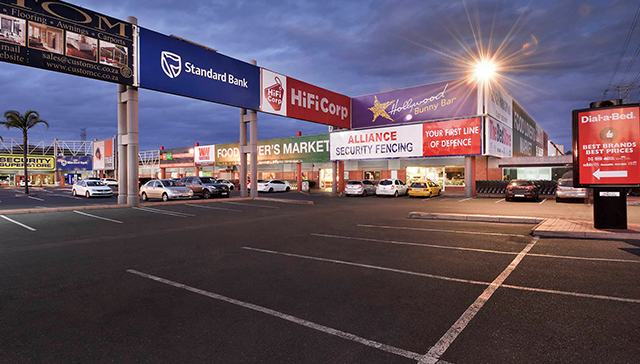
Emira Property Fund’s Springfield Retail Centre in Durban has relaunched, a year after it was damaged by arson in the widespread devastation of July 2021, where looters made their way into the centre ransacking most of its stores.

The mayhem culminated in an arson attack the next day, with fires starting at Mambo’s Plastic Warehouse and burning along a line of shops, including the centre’s electrical room.

The rebuilding, restoring, and refreshing of the 17 300m2 community-focused lifestyle centre began immediately, with the assistance of the community. Most of the centre was reinstated and trading within a few weeks of the damage occurring, and Emira had the maximum amount of SASRIA cover in place to adequately cover any damages and loss of trading.

Fortunately, only one wing of the centre had structural damage, and around 30% of Block A was cordoned off safely without affecting trade in the rest of the centre, including anchors Food Lovers’ Market, HiFi Corp and Baby City.

As part of reinstating the centre, Emira took the opportunity to refresh and refine its tenant mix and reconfigure space to improve the overall shopping experience.

We considered general shopping trends, monitored consumer patterns in Springfield Retail Centre’s catchment area and observed the centre’s tenant performance in order to identify improvements for its offering and match them with the type of retailers that would work best for the refreshed centre and its shoppers,” explains Ulana van Biljon, Emira COO.

This included improving the centre’s tenant mix and reconfiguring an underutilised part of the property to create floor space for Coricraft’s new home and décor showroom. The Coricraft concept store opened in April this year, with a new layout and design unique to Springfield Retail Centre. Similarly, Ted’s Home Store also took the opportunity to upgrade its 1 000m2-plus store at Springfield Retail Centre to create an all-new showroom, which opened in May 2022. The combined impact has created one of the strongest home and décor retail offerings in the region.

Finally, most of the restoration work has been completed and Springfield Retail Centre is already trading fully with only Westpack still to open at the end of August 2022. The open-air shopping experience has a refreshed array of tenants, from fashion and home furnishings to babies, tech and more.

The post Emira’s Springfield Centre in Durban ‘rises from the ashes’ with a relaunch appeared first on Emira Property Fund.

Emira’s Springfield Retail Centre relaunches a year after it is burned by looters

Emira Property Fund (JSE: EMI) has relaunched its Springfield Retail Centre in Durban, KwaZulu-Natal, a year after the centre was damaged by arson in the widespread looting and devastation of July 2021.

Starting back on 12 July 2021, looters made their way into the centre and ransacked most of its stores. The mayhem culminated in an arson attack the next day, with fires starting at Mambo’s Plastics Warehouse and burning along a line of shops, including the centre’s electrical room.

The rebuilding, restoring and refreshing of the 17,300sqm community-focused lifestyle centre began immediately, with the community coming out to help. Most of the centre was reinstated and trading within a few weeks of the damage occurring, and Emira had the maximum amount of SASRIA cover in place to adequately cover any damages and loss of trading.

Fortunately, only one wing of the centre had structural damage, and around 30% of Block A was cordoned off safely without affecting trade in the rest of the centre, including anchors Food Lovers’ Market, HiFi Corp and Baby City. While work continued on the fire-damaged section, a concerted communications effort let shoppers know the property was open and which stores were trading. As part of reinstating the centre, Emira took the opportunity to refresh and refine its tenant mix and reconfigure space to improve the overall shopping experience.

“We considered general shopping trends, monitored consumer patterns in Springfield Retail Centre’s catchment area and observed the centre’s tenant performance in order to identify improvements for its offering and match them with the type of retailers that would work best for the refreshed centre and its shoppers,” explains Ulana van Biljon, Emira COO.

This included improving the centre’s tenant mix and reconfiguring an underutilised part of the property to create floor space for Coricraft’s new home and decor showroom. The Coricraft concept store opened in April this year, with a new layout and design unique to Springfield Retail Centre. Similarly, Ted’s Home Store also took the opportunity to upgrade its 1,000sqm-plus store at Springfield Retail Centre to create an all-new showroom, which opened in May 2022. The combined impact has created one of the strongest home and décor retail offerings in the region.

Finally, most of the restoration work has been completed and Springfield Retail Centre is already trading fully with only Westpack still to open at the end of August 2022. The open-air shopping experience has a refreshed array of tenants, from fashion and home furnishings to babies, tech and more.

The effectiveness of its strategic re-leasing is evident in the return of customers to Springfield Retail Centre, notwithstanding current economic pressures.

Emira applies its strategic leasing philosophy to all its shopping centres, constantly gathering data to keep track of macro and local market trends, analysing how different tenants are performing and considering this in relation to their position and adjacencies within a centre.

“Using these insights, we aim to place the best retailer into an optimally-sized store in the ideal location within a centre in order to benefit its customers, trading, neighbouring stores, the mall’s overall flow and its capacity to attract buying power,” says van Biljon.

She adds, “Signing a make-do lease to fill a vacancy without considering these factors is often a short term and potentially very costly exercise. By emphasising what our customers want, our strategic leasing supports excellent trading densities for tenants and the good performance of our retail assets.”

Strategic leasing for Emira is definitely not a one-size-fits-all process. It recently completed another such project for a very different asset – the large 91,000sqm regional Wonderpark Shopping Centre in Pretoria, Gauteng.

By refreshing the retail mix, Emira was able to find ways to meet Wonderpark Shopping Centre’s customers’ latest needs in response to the emergence of quality and value as more important factors in their purchasing patterns. New tenants were added to the retail mix, while several existing tenants were relocated in the centre and right-sized. This included Clicks, Gelmar, The Bed Shop, Russells, The Hub, Mr Price Home, Fabiani, Code, Kingsmead Shoes, Ackerman’s Woman, Pep Cell and more.

The result: an increase in spend-per-head, positive turnover growth, better-than-industry footfall averages, and greater shopper cross-pollination. Put simply, the project has resulted in better trading for Wonderpark retailers and the centre, and it has attracted new tenants to this market.

“Although Springfield Retail Park and Wonderpark Shopping Centre are vastly different in size and market, they both meet Emira’s retail portfolio goals of offering South African consumers great convenience shopping experiences that are tailored to their specific shopper community,” says van Biljon.

Emira has total assets of R12.6bn, including 77 directly-held properties valued at R9.8bn in South Africa. A 17% portion of its total asset base is international, made up of equity investments in 12 grocery-anchored open-air convenience shopping centres in the USA

Emira proposes acquiring Transcend’s entire share issue with a firm offer

Emira Property Fund’s Springfield Retail Centre in Durban has relaunched, a year after it was damaged by arson in the widespread devastation of July 2021, where looters made their way into the centre ransacking most of its stores.

Emira Property Fund (JSE: EMI) has proposed a general offer to Transcend Residential Property Fund shareholders to acquire all the shares in Transcend that Emira doesn’t already own.

Transcend is a specialist REIT with a residential-only property portfolio, which listed on the JSE AltX in 2016 and migrated to the main board in 2020. In 2018, Emira secured a strategic minority stake in Transcend to expand its investment in residential property and enhance portfolio diversification.

Since its initial investment in Transcend, Emira has played a pivotal and almost exclusive role in providing capital to fund its growth. In the process, Emira has increased its equity in Transcend. Most recently, Emira was one of only a few legacy shareholders to follow their rights in Transcend’s December 2021 R156m equity raise via an underwritten vendor placement. This investment, together with a small stake acquired in an off-market trade from a major financial institution, increased Emira’s stake in Transcend to a pre-offer level of 40.69%.

However, since its listing, Transcend’s ability to grow has stalled with significant changes in the nature and dynamics of equity capital markets, particularly in South Africa. It is now restricted to issuing new equity at a substantial discount to net asset value (NAV), thereby diluting existing shareholders.

Transcend’s ability to raise equity capital stuttered in December 2021, as highlighted by its R156m capital raising where Emira was required to subscribe for an amount greater than its proportionate share. Emira has stated that it will not support the issue of further equity at a discount to NAV. Thus, Transcend’s listing, originally intended to access affordable equity capital on an efficient basis, no longer presents it with a viable or conducive means to raise significant equity. In addition, Transcend already has a relatively high loan-to-value ratio for a REIT of 44.9%. These factors severely constrain its ability to grow by adding residential assets.

Transcend also faces fundamental obstacles deterring a broader universe of institutional investors. It is a highly illiquid small-cap with less than 0.9% of its issued shares trading over the last three months. Further, its external management company structure is unpopular within the investment community.

“We firmly believe that operating Transcend in the unlisted environment is the only realistic alternative for the future, given its limitations. Controlling it as an Emira subsidiary makes sense from a cost, access to capital and investor interest perspective,” notes Geoff Jennett, CEO of Emira.

Jennett adds, “We see no benefit to maintaining two listed entry points into Transcend’s assets, which we strongly believe would be better served in an Emira-controlled subsidiary where we would be able to support the assets and prospects of Transcend without having to further increase its gearing or raising more equity as a discount to NAV. Emira is not supportive of Transcend issuing new equity capital to the extent that it results in a dilution of either Emira’s shareholding in Transcend or its NAV per share, which, other than via increasing the LTV ratio, is the only way to meaningfully fund acquisitive growth. This will constrain Transcend’s strategy to grow into a larger specialised residential REIT and, as a result, any future benefits of achieving economies of scale are unlikely to be realised. Therefore, we want to provide a once-off liquidity event to existing Transcend shareholders and ensure the focus is on driving shareholder value rather than Transcend’s size and share liquidity.”

Emira’s general offer is a liquidity event for all existing shareholders at a clean share price of R5.38 per Transcend share – representing a 17% premium on the recent vendor placement price of R4.60, which most legacy shareholders declined to take up. This once-off liquidity event also represents a 12% premium to the effective R4.80 clean closing price of 8 July 2022. The clean share price will be escalated by an estimated distribution accrual per share for the applicable distribution period up until the finalisation date of the offer.

Emira has already received irrevocable undertakings from 16.7% of existing shareholders to support the general offer. Should competition commission approval be obtained and the general offer runs its course, this would effectively give Emira a minimum 57.4% stake in Transcend.

“We are confident the December 2021 vendor placement price most accurately reflects shareholders’ perceived value of Transcend, and the premium offered represents good value to those shareholders seeking an exit strategy to realise the value of their investment,” comments Jennett.

For Emira shareholders, the consolidation of Transcend as a listed subsidiary is a logical progression of its residential rental property strategy that it embarked on in 2018. It will result in value accretion for both Emira’s distributable income per share and NAV per share.

“This transaction achieves more than shifting our indirect investment in Transcend’s assets into a directly-held residential-to-let property portfolio. By taking Transcend in-house, Emira would realise value for shareholders by adding the advantage of critical mass, removing cost duplication on a corporate level, enabling better access to capital, and driving increased stakeholder value. At the same time, we would honour existing management arrangements with IHS for continuity of operations across the Transcend assets,” explains Jennett.

Emira has posted the necessary cash guarantees with the Takeover Regulation Panel for the value of the full offer. It used a new specific R500m facility from Rand Merchant Bank and available cash. Proceeds from Emira’s planned sale of its stake in Enyuka will comfortably settle this new facility and support its ongoing capital recycling programme.

Emira is a leading diversified REIT invested in a quality, balanced portfolio of retail, office, industrial and residential properties. Emira’s rental residential property exposure includes its stake in
Transcend and a direct investment in The Bolton, Rosebank with co-investor the Feenstra Group. Emira has total assets of R12.6bn, including 77 directly-held properties valued at R9.8bn in South Africa. A 17% portion of its total asset base is international, made up of equity investments in 12 grocery-anchored open-air convenience shopping centres in the USA.

Nurturing broker-tenant-landlord relationships for shared long-term value

IN CONVERSATION WITH: Ulana van Biljon, COO, Emira Property Fund

For everybody — and certainly those in the property industry — the past two pandemic-fuelled years have been one big question mark.

The situation has had an immense impact on brokers, in particular. After Covid-19 first spread in South Africa, commercial leasing held its breath, and waited and watched the pandemic’s progress without much activity for several months.

Leasing has since resumed, but as we move towards recovery from the steps taken to manage the effects of Covid-19, commercial real estate remains a somewhat uncertain and nuanced landscape. The good news is that a return to some semblance of normalcy is likely to continue, albeit at an uneven pace in different sectors, each with its unique driving forces.

But there are still lingering effects from the pandemic. Social distancing has changed the way people interact and how businesses inhabit physical space. The market is also being driven by a deep recession from which South Africa has not yet fully emerged. These factors have softened demand for office space, increased supply and fuelled an extremely competitive environment. Doing business has become much tougher for brokers.

With this in mind, at Emira, we have spent much of the pandemic period redoubling our efforts to show the broking community that we value them and to find new ways to reward them for their hard work. Watching our broker relationships endure and flourish during the most challenging times has been an absolute highlight.

The broker community is extremely important to Emira as most new letting is done through external brokers. Our brokers provide us with the opportunity to meet, understand the space requirements and forge a genuine connection with prospective clients. We recognise the hard work, dedication and loyalty of these external stakeholders and nurture the landlord-tenant-broker relationship to create shared long-term business value.

Emira ensures regular interaction with brokers through our website, vacancy portal, social media, personal interaction, building visits and well-established annual broker incentive programme. We have had to reinvent our broker incentives in this new environment. Instead of travel rewards, made impossible by restrictions, we began acknowledging outstanding broker performance by delivering incentives such as coffee machines, printers, comfortable office chairs and shopping vouchers. We were pleased to find new Covid-safe ways to engage and extend our thanks to our brokers for their commitment, attitude and excellent work.

As a culture-centred business, we believe that our relationships with the broker community should be emblematic of our tenant relationships – in fact, all our relationships. We believe in acting with integrity, respect and trust. Brokers are an extension of our business. They are part of our team.

When it comes to our brokers, we are there to assist whatever needs they have, as is the Emira way. Our structure includes in-house broker consultants who maintain key relationships with the broking community and facilitate new leasing in the portfolio and ensure that it runs seamlessly from day one. Essentially it is a concierge platform where brokers can plug into our business, and which guides them and prospective tenants through the leasing process.

We have looked at the touchpoints in the leasing journey and tried to make each one straightforward and effortless. It’s all about considering how we can help brokers and tenants in ways other than simply signing a deal -from helping to match a business with a suitable building and space to FICA requirements and lease administration. Emira’s leadership also helps to provide highly targeted and tenant-specific decisions. We understand that many businesses are unique and go beyond a one-action-fits-all-tenants approach.

Our broker relationships have come through this challenging period stronger than ever, and we are operating together at a whole new level. Our focus on building great broker relationships has enhanced the flow of market intelligence to Emira. Our brokers give us access to a world of market knowledge and are a valuable source of information about trends and rentals and consult us on new solutions to improve the experience at our properties.

I am fortunate to enjoy good, long-lasting relationships with many members of the broking community and am looking forward to connecting more personally with them once again. While Emira’s purpose is providing great real estate, we also do business with great people, and we enjoy and appreciate working together.

The post Nurturing broker-tenant-landlord relationships for shared long-term value appeared first on Emira Property Fund.

Emira agrees to sell Enyuka shareholding to One in R637 million transaction

Emira Property Fund (JSE: EMI) has, subject to financing conditions precedent normal for this sort of transaction, agreed to sell its entire 49.9% stake in Enyuka Property Holdings, its rural and lower LSM retail property joint venture with One Property Holdings, to its venture partner for R637m, representing a small premium to book value.

Exiting Enyuka is a natural next step for Emira, which in 2016 contributed 15 rural retail assets from its direct portfolio into the Enyuka portfolio in exchange for the 49.9% shareholding. It teamed up with experts in this specialist area of retail property, One, to collectively derive more value and greater growth from the portfolio.

In the six years since, the jointly managed portfolio has achieved its objective of creating value for Emira shareholders, growing from 15 assets valued at R575m to 24 assets valued at R1.67bn. The original five-year plan for Enyuka included options to extend the agreement and for a partner buy-out. It was extended twice, for a year each time.

Geoff Jennett, CEO of Emira, says, “The Enyuka joint venture has worked well – so well that our partners offered to buy us out. This is an attractive exit from a non-core investment for Emira at a good price in a single transaction. We weren’t actively looking to sell our Enyuka stake, but the offer from One has presented us with a great opportunity that is well-aligned with our stated strategies. The cash realisation enables us to redeploy the capital into our core strategies. It provides Emira with optionality in its capital allocation and agility to respond to clear and attractive market opportunities.”

The proceeds, equal to about 5% of Emira’s total asset base, will be temporarily deployed to reduce Emira’s gearing but be immediately available for other capital re-investment opportunities

Jennett adds, “The Enyuka assets will remain in good hands with One, for which rural and lower LSM retail property investment and management is a core specialisation. One has been instrumental in the asset management and expansion of the portfolio since the inception of the JV.  They remain passionate about rural retail and are well positioned to take the portfolio forward and to further grow the asset base. We look forward to continuing our good relationship with One as part of the Inani Property Holdings consortium.”

Emira is a leading diversified REIT invested in a quality, balanced portfolio of retail, office, industrial and residential properties. Should the transaction proceed, it will have total assets of R12.6bn, including 77 directly-held properties valued at R9.8bn in South Africa. A 17% portion of its total asset base is international, made up of equity investments in 12 grocery-anchored open-air convenience shopping centres in the USA.

The transaction remains subject to several conditions being fulfilled.